Engineering & Hardware Analysis

Cleaning Technology Trends

An engineering evaluation of solid-state sensor arrays, active thermal wet scrubbing, and micro-particle dirt profiling redefining modern residential floor care.

Key Engineering Takeaway

Recent hardware iterations highlight a definitive move away from passive suction toward dual-phase chemical-free floor sanitation, multi-spectrum debris characterization, and zero-tangle conical turbine rollers.

Table of Contents

Autonomous Systems

Solid-State Navigation and Dynamic Obstacle Profiling

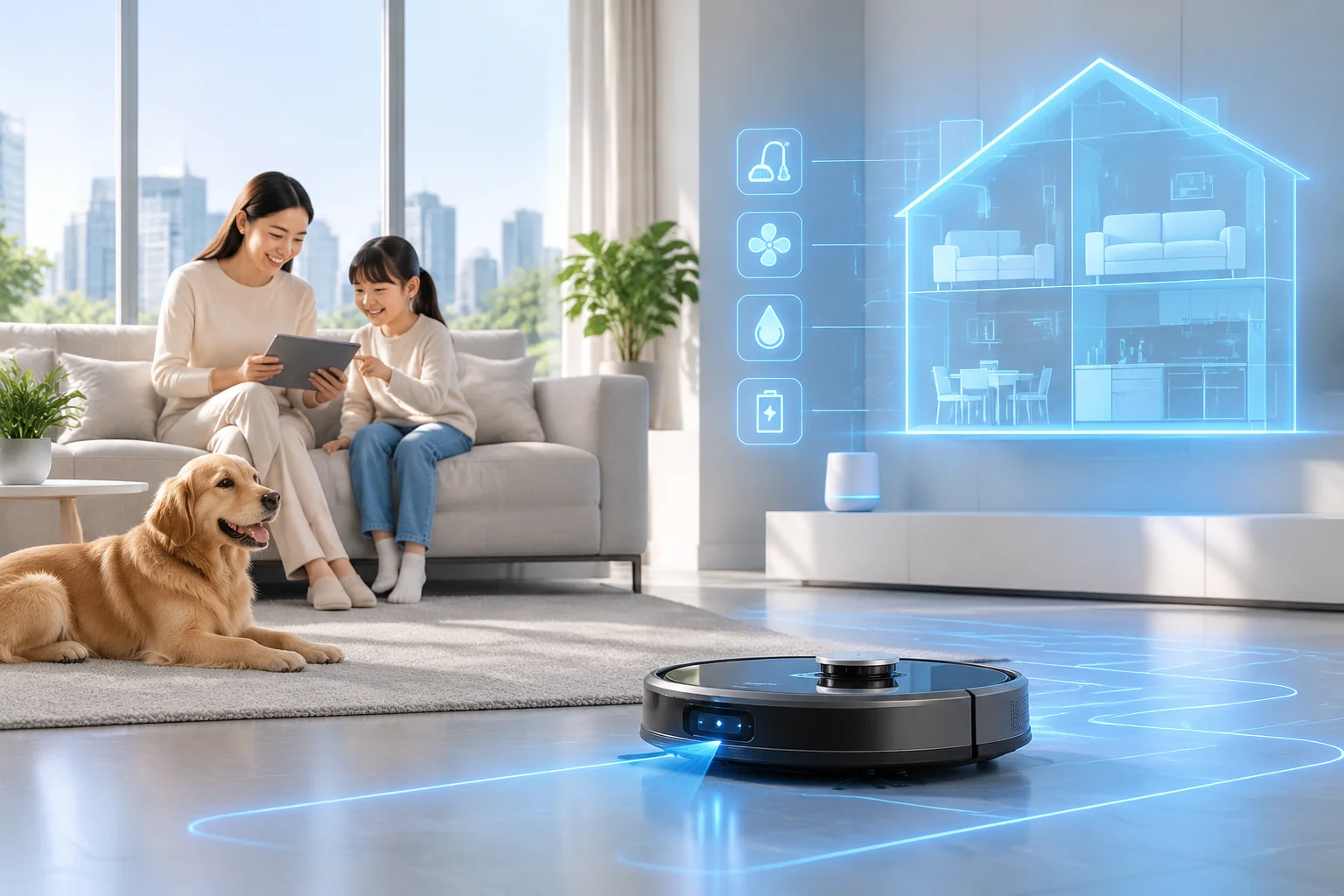
Domestic vacuum equipment in 2026 relies on solid-state optical arrays and localized neural coprocessors rather than mechanical bumpers. These embedded systems identify low-profile floor hazards like charging cords, pet bowls, and deep pile transition strips with millimetre precision.

Acoustic piezo sensors directly mounted behind the intake duct continuously measure particle collisions. When fine grit or salt crystals strike the chamber, the controller increases motor amperage instantly, returning to baseline wattage once the intake stream clears.

  • Solid-state LiDAR modules operate without moving parts, extending hardware lifespan and eliminating dust occlusion.
  • Edge-detection algorithms calculate micro-offsets around furniture legs without touching sensitive wood finishes.
  • Real-time surface impedance sensors modulate roller height to prevent carpet fiber binding.
Cleaning Technology Trends
Thermal Mechanics

Active Hydro-Scrubbing and Self-Descaling Docks

Wet floor maintenance has advanced beyond passive microfiber dragging. Dual counter-rotating scrubbing heads apply continuous downward pressure while fresh water manifolds inject precise liquid doses, emulsifying dried stains before moisture can soak floorboard seams.

Base stations now combine flash water heaters with automated high-speed centrifuge cycles. Washing pads in water reaching 60°C strips greasy kitchen residue, followed immediately by 45°C filtered air desiccation to halt mildew formation inside sealed bases.

“Flash water heating coupled with continuous sealed air desiccation has resolved the primary hygiene pitfall of robotic floor maintenance: bacterial buildup in damp mop textiles.”

2026 Technical Benchmark Metrics

Operating Motor Suction8,000 – 12,000 Pa
Station Water Heating55°C – 65°C Flash Heater
Acoustic Dirt Sampling15,000 pulses/sec
Brush Anti-Tangle Efficiency99.4% Zero-Wrap Ratio
Data Summary

Core Technological Shifts Across Modern Cleaning Hardware

  1. Acoustic Piezo Sensing Microphones track microscopic debris strikes against the suction duct, throttling brushless motor wattage only when heavy grime passes through to preserve battery capacity.
  2. Sealed Multi-Stage Separation Cyclonic assemblies isolate 99.99% of particulate down to 0.1 microns, capturing ultra-fine winter salt dust, pet allergens, and carbon soot before air exhausts.
  3. Cantilevered Conical Rollers Reverse-tapered brush bars channel long human hair and animal fur toward an open drive axle, preventing bearing binding and eliminating manual roller slicing.
  4. Automated Solution Proportioning Docking reservoirs meter surfactant concentrations at strict 1:200 ratios, stopping sticky chemical residue from dulling engineered hardwood floors.
Common Inquiries

Frequently Asked Questions on Cleaning Tech Trends

Solid-state LiDAR uses stationary semiconductor emitter arrays rather than a spinning mechanical turret. This design eliminates belt fatigue, lowers the total chassis height by nearly two centimetres, and avoids drive-motor burnouts caused by pet hair accumulation in the turret housing.

Modern docking stations rely on on-demand flash heaters rather than constantly heated water tanks. The element draws peak wattage for only 90 to 120 seconds per wash cycle, resulting in negligible electricity consumption across typical weekly cleaning schedules.

Conical rollers exploit centrifugal force and tapered diameters. Hair strands naturally spiral toward the narrower cantilevered end, where suction velocity is concentrated, directing strands straight into the intake duct rather than wrapping tightly around a central metal axle.

Instead of running the motor continuously at maximum boost mode, acoustic sensors register microscopic particle impacts. The controller limits high-drain suction strictly to heavily soiled patches, preserving lithium-ion cells from excessive heat and extending runtime by up to 40%.

During Canadian winters when windows remain closed and furnaces cycle continuously, vacuums should feature fully sealed H13 or H14 HEPA filtration. This ensures exhausted air does not recirculate sub-micron salt dust, furnace soot, or household dust mite antigens.

Yes. The newest generation of spatial computing modules processes all room geometry, obstacle recognition, and path planning directly on local hardware chips, ensuring complete operation and privacy even when disconnected from external networks.

Advanced floor washers use peristaltic pumps that deposit micro-metered films of moisture immediately gathered by high-speed squeegee channels, leaving surfaces dry within 90 seconds and protecting floorboard joints from swelling.

Equipment Inquiries

Explore Advanced Vacuum Engineering Solutions

Compare verified Canadian performance ratings on robotic systems, high-efficiency cordless sticks, and cyclonic central vacuums.